

Do you want to start a business as a sole trader in the UK and are wondering about the CWF1 form? If yes, you have probably met the CWF1 form.
CWF1 form is one of the most important official documents. HMRC uses it to register individuals for self-employed and Class 2 National Insurance contributions.
You are a freelancer, a contractor, or running a small side business as a sole trader. It is mandatory to inform HMRC by 5 October, following the end of the tax year, using the CWF1 form.
You can face a late-registration penalty if you miss this deadline, even if you haven’t earned much yet. TAJ Accountants will help you understand the details of the CWF1 form. At the end of the reading, you’ll know exactly what to do to get your tax affairs off to the right start.
What is a CWF1 Form?
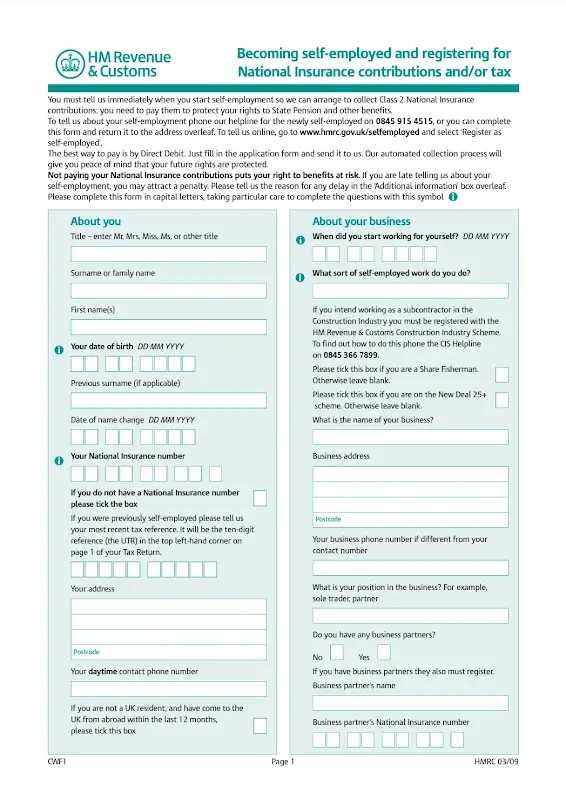
A Construction Workers Form 1 (CWF1) refers to the HMRC official form used to register or re-register as a self-employed worker. When you submit this form, you tell HMRC that you are responsible for paying your own taxes and National Insurance contributions (NIC). Example: a CWF1 form.
Who Needs to Complete a CWF1 Form?
You need to complete and submit a CWF1 form if:
- you started working as a self-employed individual, such as a freelancer, trader, consultant, etc.
- receive income without tax at source. For example: your clients pay you directly.
- you independently sell goods or your services.
- start a partnership business, each partner must register separately for Self Assessment.
- earn more than the threshold, and it is £1,000 in a tax year.
If your earnings are less than this threshold of £1,000 from your self-employment, you won’t need to submit the CWF1 form. But if you wish, you can register it voluntarily.
How to Get a CWF1 Form
The quickest way to get a CWF1 form is by registering online through your HMRC Government Gateway account. Visit gov.uk, select “Register if you’re self-employed,” and follow the steps to complete your registration. You will need a Government Gateway user ID and password. If you do not already have an account, you can create one before you begin.
You can also download, print, and post a paper CWF1 form to HMRC if you are unable to register online. However, online registration is usually faster. It also automatically creates your HMRC account and confirms receipt of your registration. Before you start, make sure you have all the required information, as you cannot save a partially completed online application.
Once your registration is submitted, HMRC will send your Unique Taxpayer Reference (UTR) by post. This can take several weeks to arrive. Register as early as possible rather than waiting until the October deadline. Delays with the post or identity checks could prevent you from receiving your UTR in time.
Difference Between a CWF1 Form and An SA1 Form?
Both forms are used to register for Self Assessment with HMRC, but they serve different purposes and cannot be used interchangeably.
The CWF1 form is for sole traders who are starting a business. It tells HMRC that you are self-employed and registers you for Class 2 and Class 4 National Insurance contributions at the same time.
The SA1 form is for individuals who need to register for Self Assessment for reasons other than self-employment. This may include receiving rental or investment income, or serving as a company director.
CWF1 Form | SA1 Form |
Who it is for Sole traders starting a business | Who it is for Individuals who need Self Assessment for reasons other than self-employment |
What it does Registers you as self-employed and for Class 2 and Class 4 National Insurance | What it does Registers you for Self Assessment only |
When to use it Starting as a freelancer, sole trader, or self-employed individual | When to use it Receiving rental income, investment income, or other non-employment income |
National Insurance registration Yes, Class 2 and Class 4 | National Insurance registration No |
Company directors Not applicable; directors generally use SA1 | Company directors Yes |
Partnerships Not applicable; partnerships use SA400 and SA401 | Partnerships Not applicable |
What Do I Need to Include in The CWF1 Form?
Before completing the CWF1 form, gather all the information you need. The online application cannot be saved partway through, so it is best to complete it in one session.
You will first need to provide your personal details. This includes your full name, date of birth, National Insurance number, and home address. If you cannot find your National Insurance number, you can locate it on your payslips, HMRC letters, or in the HMRC app.
Next, you will need to enter details about your business. This includes the type of work you do, your trading name, your business address, and the date you started, or intend to start, self-employment. HMRC uses your start date to determine the relevant tax year and when your first Self Assessment tax return will be due.
If you are registering for Making Tax Digital (MTD) for Income Tax, make sure your digital record-keeping system is ready from the start. From April 2026, MTD applies to self-employed individuals and landlords with qualifying income above £50,000. Registering correctly from the beginning can help you avoid unnecessary corrections later.
Stay Updated
Get expert accounting advice tailored to your business needs
CWF1 Deadline
You must register with HMRC by 5 October following the end of the tax year in which you started trading. Missing this deadline could incur a penalty, with the amount increasing depending on how late you register.
The deadline is based on the tax year, not the calendar year. For example, if you started trading in July 2025, you fall within the 2025/26 tax year. You must register by 5 October 2026.
Do not wait until the deadline to register. After submitting your CWF1 form, HMRC will send your Unique Taxpayer Reference (UTR) by post. This can take several weeks. Delays with the post or identity checks could leave you without your UTR in time to submit your Self Assessment tax return by the 31 January filing deadline.
Conclusion
The CWF1 form is one of the first and most important steps when becoming self-employed in the UK. It registers you with HMRC, sets up your Self Assessment record, and ensures your National Insurance contributions are recorded correctly from the start. Registering early gives you enough time to prepare before your first tax return is due.
If you are also affected by Making Tax Digital (MTD) for Income Tax, registering correctly from the beginning helps ensure your digital records and reporting processes are in place before the new requirements apply.
TAJ Accountants is a small business accountants firm helping sole traders and self-employed individuals across London register with HMRC, set up their records correctly, and stay compliant throughout the year. Book a free consultation if you are not sure where to start.
Frequently Asked Questions
The CWF1 form is used to register as self-employed with HMRC. It tells HMRC that you have started working for yourself, sets up your Self Assessment record, and registers you for Class 2 and Class 4 National Insurance contributions. Registering ensures your tax and National Insurance obligations are recorded correctly from the start.
No. If you already have a Unique Taxpayer Reference (UTR) because you are a company director, receive rental income, or were previously self-employed, you should not submit a new CWF1. Doing so may cause HMRC to create a duplicate record or reject your application. Instead, update HMRC through your existing Personal Tax Account or follow the appropriate re-registration process if you are returning to self-employment. The CWF1 form is only for people registering as self-employed for the first time.
No. The CWF1 form only registers you for Income Tax and National Insurance. If your taxable turnover exceeds the VAT registration threshold, you must register for VAT separately through HMRC. Registering with CWF1 does not automatically register your business for VAT.
Missing the 5 October registration deadline can fail to notify penalty from HMRC. The amount depends on the tax owed and how late your registration is. HMRC’s points-based penalty system may also apply. In many cases, registering late but submitting your Self Assessment tax return by 31 January and paying any tax due on time may avoid a penalty. However, this is not guaranteed. Registering on time is the best way to avoid unnecessary risks.
Yes. If your self-employment income exceeds the £1,000 trading allowance in a tax year, you must register with HMRC, even if you also have a full-time job. Income below the trading allowance usually does not need to be reported, but earnings above that threshold require registration.
HMRC usually processes a CWF1 registration within two to four weeks. Your Unique Taxpayer Reference (UTR) is then sent by post to your registered address. Registering early gives you enough time to receive your UTR before the 31 January Self Assessment filing deadline.